
SEO in 2026 is no longer just about ranking higher and earning clicks. With AI Overviews and AI Mode changing how users discover information, brands now need content that is useful, trustworthy, easy to understand, and easy for AI systems to reference.
Google confirms that traditional on-site SEO is still the foundation for visibility in generative AI search. This shift has made SEO, AEO, and GEO increasingly important for staying visible across both traditional search and AI-powered answers. In this guide, we’ll explore how search has changed, what AI systems reward, and how to future-proof your SEO strategy in 2026.
From Ten Blue Links to Answer Engines
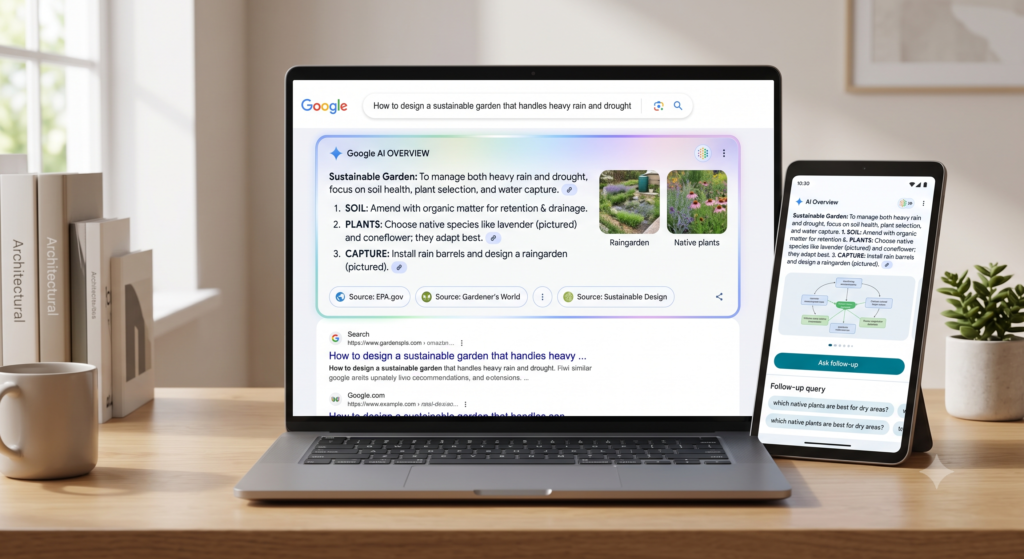
In 2026, search is moving beyond the traditional “ten blue links” toward AI-powered experiences that answer queries directly. Google’s AI Overviews can summarize information within the search results, while platforms such as ChatGPT and Perplexity provide answers without requiring users to visit multiple websites.
This shift is already affecting organic traffic. I have seen a client’s page ranking #4 for months, however, it got zero clicks as most factual based queries are resolved within seconds through AI Overviews generated summaries.
According to Ahrefs’ December 2025 analysis of 300,000 keywords, the presence of an AI Overview was associated with a 58% lower CTR for the top-ranking result.
As users increasingly get answers without clicking through, ranking #1 alone is no longer the complete goal. SEO now also needs to focus on creating content that AI systems can understand, trust, reference, and cite.
Where AI Overviews Stand Right Now
AI Overviews are becoming a major part of Google Search, but their reach and click impact vary by query and dataset. Recent 2026 studies show that AI Overviews can significantly reduce organic clicks, while cited pages generally perform better than uncited ones.
- Between Feb 2025-Feb 2026, AI Overviews coverage grew from 31% to 48% of tracked queries. This 17-point jump indicates how users are finding information on the search engines.
- When an AI Overview appears, only 8% of users click through to a traditional result, down from 15%. “Zero-click” has become the norm now. When users find instant information on the top of the search results page, the traditional CTR will gradually drop down.
- Getting cited inside the AI Overview is considered as the new ranking #1. If your website is getting cited in AI Overview, it is viewed as a highly authoritative source of information.
For one of my clients, I wrote an article packed with valuable, people-first information, and it was cited by AI even though it still hasn’t reached the first page of Google. This shows that AI visibility isn’t limited to pages that rank on page one of the SERPs.
Traditional SEO vs AEO vs GEO
| Aspect | Traditional SEO | AEO | GEO |
| Definition | Optimizes pages for search rankings | Optimizes content for direct answers | Optimizes content for AI-generated answers |
| Goal | Rank higher and drive clicks | Become the direct answer | Get mentioned or cited by AI |
| Primary Metric | Rankings, traffic, CTR | Answer and snippet visibility | AI mentions and citations |
| Example Tactic | Keyword optimization, backlinks, technical SEO | FAQs, Q&A content, concise answers | Original data, expert insights, credible sources |
None of SEO, AEO, and GEO replace the other. In fact, they stack. If you have seen a page that ranks well, answers directly, and is also cited by AI Overviews, showcases that it is doing all three at once.
Who AI Actually Cites
AI engines mostly cite independent third parties, not brand-owned websites. Roughly 82% to 95% of citations point to earned media, industry journalism, community forums like Reddit, and YouTube videos.
Algorithms lean on this kind of independent consensus and structured comparison data instead of self-promotional corporate copy, because it reflects real-world sentiment rather than a company’s own pitch.
What AI Search Engines Actually Reward
AI search increasingly favors content that is clear, useful, original, and easy to understand. Google’s current guidance emphasizes people-first content, unique insights, strong experience and expertise, and a clear technical structure.
Structure for Extraction
AI search engines actually reward structures that are clean and easy to extract. Follow these guidelines:
- Put the direct answer in the first 50 words
- Use Question-based H2/H3 headings
- Break complex information into short paragraphs, lists, and tables.
- Focus on useful information instead of unnecessary length.
E-E-A-T’s New Weight
Google’s 2026 recent core update confirmed that adding real experience is the biggest uplifting factor. To get cited in AI Overview, prefer adding real first-hand experiences, specific outcomes, user involvement, over plain blocks of texts.
Author credentials have become a part of this conversation too, which means a byline with author credentials can genuinely increase your chances of AI citations as it is treated as trust infrastructure.
People prioritize genuine experiences because of which you might see a lot of content like “I analyzed, tried, and figured…” or “10 AI tools I would actually recommend after using all 50 there in the market” cited as they proved to be people-first, valuable, and extractable.
Schema as the Language AI Speaks
Content with proper schema markup has a higher chance of appearing in AI-generated answers. Focus on FAQPage schema, comparison tables, author info, as these are more likely to surface inside AI generated answers independently.
Practical Steps to Future-Proof Your Strategy
To future-proof your SEO strategy, focus on fresh, experience-led content, credible sources, and strong author credentials. Build authority beyond your website through trusted platforms, support claims with verifiable data, and use structured data where relevant. Most importantly, prioritize useful, people-first content over AI-specific hacks.
- Freshness: Update your content regularly as content under 3 months old is more likely to be cited rather than stale content.
- Off-site presence: Almost 82-95% of AI citations come from sites you don’t own, such as Reddit, YouTube, LinkedIn, Third-party sites. Hence, focus on increasing authority as community/forum/PR presence matters as much as your own site
- Verifiable data: Content backed by real statistics and named sources sees a measurable visibility lift over vague, uncited claims.
- Mark up everything, structurally: FAQs, comparison tables, and step-by-step processes should carry schema, not just visual formatting.
- Credentials, mandatory: Make author credentials with verifiable links, a mandatory part of your process.
FAQs
What is GEO in SEO?
GEO (Generative Engine Optimization) means structuring content so AI chat tools like ChatGPT and Perplexity can find it, trust it, and cite it in their answers.
Do AI Overviews kill traditional SEO?
No. AI Overviews don’t kill traditional SEO. They change what ranking #1 actually means, since you now need to pair SEO with AEO and GEO to show up in AI-generated answers too.
How is AEO different from GEO?
AEO focuses on earning direct answers within search engines themselves. GEO focuses on getting cited inside standalone generative AI tools.
Does E-E-A-T actually affect AI Overview visibility?
Yes. Google’s 2026 core update gives E-E-A-T real weight in AI Overview citations, so your content needs actual experiences, specific outcomes, and author credentials behind it.
Is schema markup mandatory now?
Not mandatory, but it matters. Pages with proper schema markup get pulled into AI-generated answers more often than pages relying on visual formatting alone.
What is a query fan-out in AI search?
Query fan-out is when Google splits one search into several hidden sub-questions and pulls answers for each from different sources. That’s why covering a topic comprehensively now matters more than chasing one exact keyword.
How can a website actually get cited in AI Overviews?
Put direct, well-structured answers in the first 50 words of a section, add schema markup, and keep content fresh. Build mentions on third-party sites too, since citations rarely depend on your own domain alone.
Do backlinks still matter for AI search visibility in 2026?
Yes, but less than before. Ahrefs data shows brand mentions across the web now correlate roughly three times more strongly with AI visibility than backlinks do, which makes off-site presence the bigger lever to pull.
What’s Next: Beyond 2026
Gartner now projects 90% of B2B buying will be AI-agent-intermediated by 2028, moving over $15 trillion in B2B spend.For content strategists, the focus is no longer just on creating content for human readers. Content now needs to be clear, structured, and easy for AI systems to understand, extract, and cite, while still providing a useful experience for people.
In 2026, AI has changed what visibility looks like, from chasing backlinks and keyword-stuffing to using credibility, experience, and extractable content as the baseline. Therefore, your SEO playbook needs to be upgraded with the changes to reclaim rankings.