
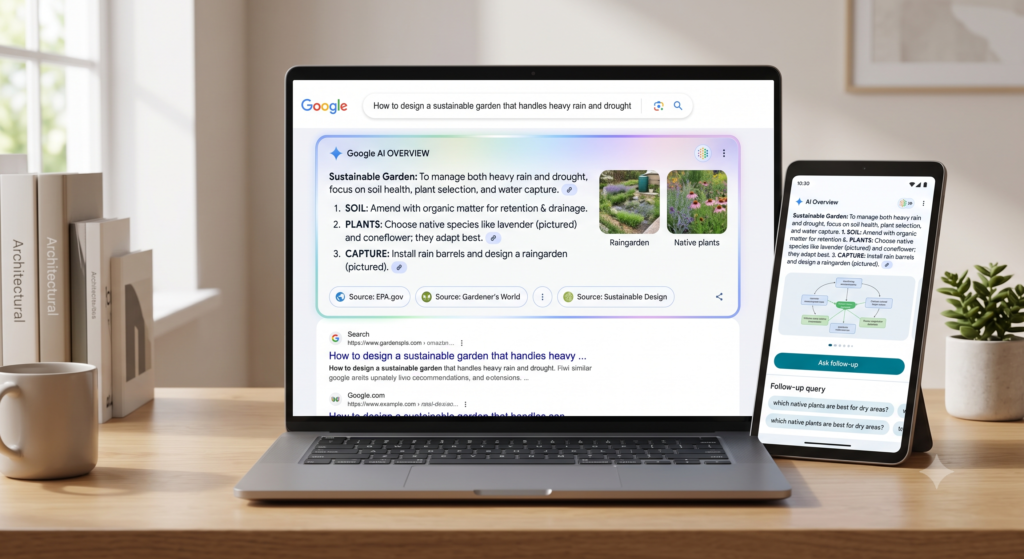
A few years ago, Google would give you a list of pages to open and compare yourself. Now, an AI Overview can pull information from several sources and give you a summary directly on the results page, with links to the pages it used.
That changes how businesses need to think about being found on Google. Ranking still matters, but AI Overviews add another way for your content to reach a user.
So what actually happens between typing a query and seeing an AI Overview? And what does that mean for SEO?
What Is Google AI Overview and How Does It Actually Work?
Google AI Overview uses artificial intelligence to generate a summary for a search query, often combining a written answer, key points, and links to the sources behind it. It doesn’t replace the traditional search results, but it changes how people discover, skim, and decide which information to explore further.
What an AI Overview Looks Like on the Results Page
When you search on Google, you may now see an AI-generated summary at the top of the results. Unlike a featured snippet, which pulls a passage from one webpage, an AI Overview draws from several webpages at once, which is exactly why clear, well-structured, trustworthy content matters if you want yours to be one of them.
The Query Fan-Out Mechanism Behind It
When you ask Google a complex question, it can break that question into several smaller searches to gather the information needed for an answer.
- Break it down: Google identifies the different pieces of information needed to answer the question.
- Search: It explores related queries and sources to find that information.
- Put it together: It combines those findings into one answer that addresses the original question.
For example, imagine you search: “What are the PPC trends in 2026?”
Google may break that into related questions about AI-powered bidding, automation, ad formats, audience targeting, and privacy before combining information from different sources into one answer.
Where AI Overview Pulls Its Information From
AI Overview can draw information from several places, including Google’s own databases, websites, and user-generated content.
Google’s Knowledge Graph
Google uses its Knowledge Graph to understand entities such as people, places, brands, and organizations. This gives AI Overview factual context about the things mentioned in a query.
Google’s own databases and tools
Products such as Google Maps, Google Business Profile, and other structured Google data provide information that can help AI Overview understand businesses, locations, products, and other real-world entities.
Websites
AI Overview can pull information from webpages and cite them as sources. This makes clear, useful, well-structured, and trustworthy content important for brands that want their information to be surfaced.
User-generated content
Reviews, photos, forums, and social posts show what people are actually saying about a business. When relevant to a query, AI Overview can pick up information from these sources and use it in its answer.
Why AI Overview Is Changing SEO
For years, SEO followed a simple path: rank higher, get more clicks. Users searched for something, Google showed a list of pages, and websites competed to appear near the top.
AI Overviews change this because Google can now answer the query before a user visits any website. If the overview already gives someone enough information, there is less reason to click through to the traditional search results.
That means SEO is expanding beyond rankings. Getting found still matters, but so does becoming a source Google can use in its AI-generated answers. Content needs to answer questions clearly, provide useful information, and make the topic easy for Google to understand.
How to Get Your Content Cited in AI Overview
There is no fixed formula for getting cited in an AI Overview. But some things can make your content easier for Google to understand and use.
- Follow query fan-out: Think beyond the main query and cover the related questions Google may need to answer. For example, if someone searches “How does Google AI Overview work?”, they may also want to know about sources, citations, query fan-out, and its impact on SEO.
- Give the answer early: Don’t make people read half the article before they find what they came for. Put the main answer near the top and use the rest of the section to explain it properly.
- Back important claims with evidence: Use reliable sources, current data, or examples where they add value. Show your expertise and give readers enough depth to trust the information.
- Keep the structure clear: Use headings that tell the reader exactly what they’re about to read. Short paragraphs, bullet points, steps, and tables can also make a long topic easier to follow.
Note: These are not “AI Overview hacks.” They are basically good content practices that also make your page easier for Google to understand and evaluate. Google itself recommends creating original, people-first content that provides real value beyond what other pages already offer.
Author’s Take
After working in digital marketing for over two years, I’d say this: if you want clicks and AI citations, focus on creating content that genuinely helps the reader. Google is getting better at identifying shallow, repetitive information, so simply covering a keyword is not enough anymore.
The search landscape is evolving, but one thing still matters: depth and expertise. When your content answers the question properly, adds useful context, and gives the reader something they can actually use, it has a stronger chance of standing out in both traditional search and AI-generated results.
Frequently Asked Questions
Key Takeaways
- AI Overview adds another layer between a search and a website. The user may get an answer first and decide whether a click is necessary.
- Query fan-out makes broader topic coverage more relevant. One search can lead Google to several related questions before it forms an answer.
- Your content can appear in the answer without being the answer’s only source. Google may combine information from your page with information from other sources.
- The work that gets you cited is the same work that makes content worth reading in the first place.
- The opportunity is bigger than one Google feature. Content built around real knowledge can support search visibility, user trust, and future content across multiple channels.